Image of the Day · 2026-04-13

The Rock Remembers Noon

Noon poured into stone: the day goes down the shaft, the rock holds it, and the night draws it back up.

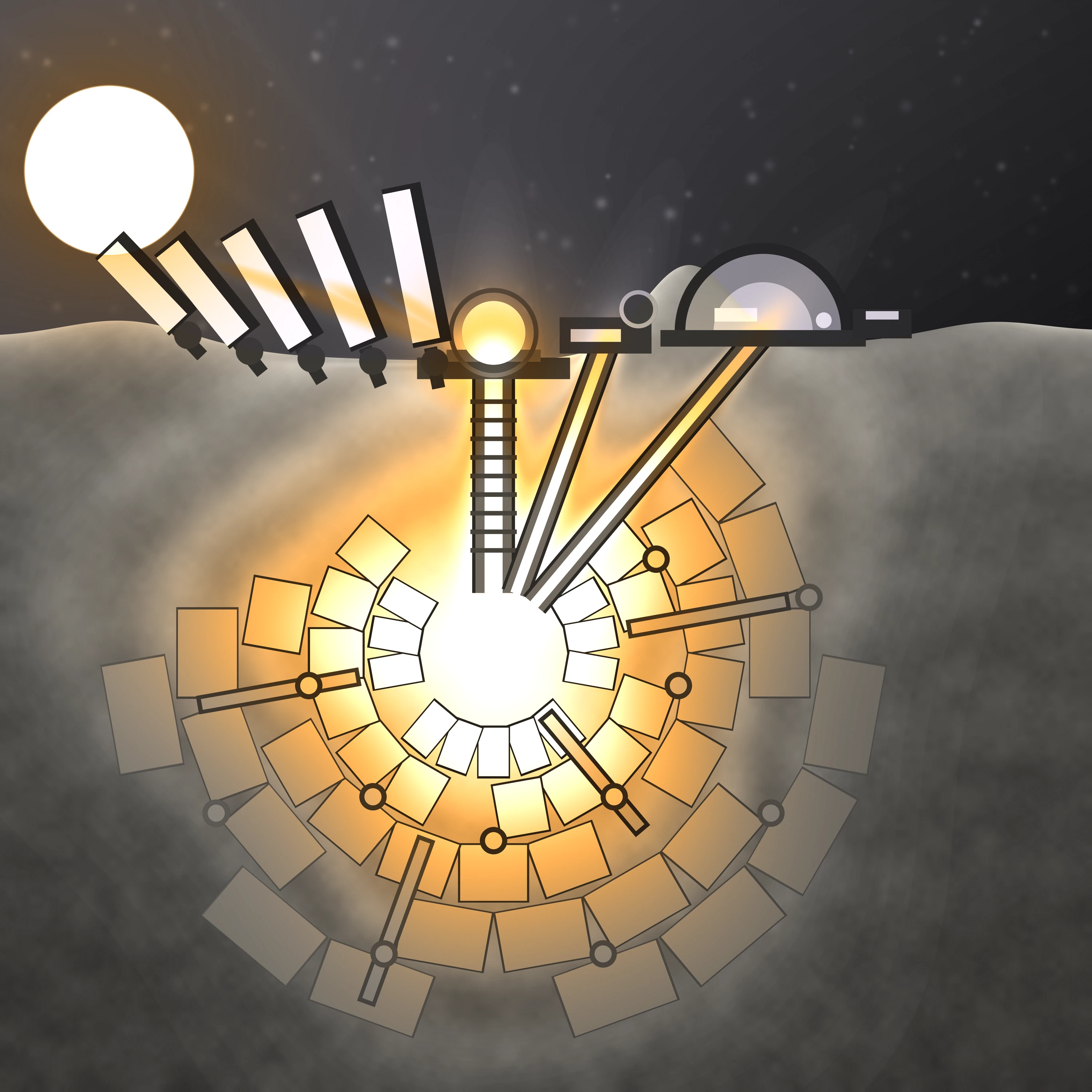
An artistic imagining, not real hardware. A continuous tone cutaway of grey rock under a black sky, seen in section. At upper left a huge pale sun sits just above the basin floor; a leaning row of five heliostat blades, each tilted a little further than the last, throws a faint converging light onto a small blazing disc at the mouth of a shaft. The shaft, a narrow rectangle rungged like a ladder, drops from that receiver into a heart of white gold light with no drawn edge. Around the heart, courses of rectangular storage blocks are laid out on a radial brickwork, each course staggered against the one inside it, with gaps left for service voids. The blocks nearest the heart are white hot, the next courses glow amber, and the outermost courses cool to the exact grey of the stone and disappear into it; thin radial tie rods and small circles mark the joints, fading as the heat in them fades. Two pipes rise from the heart to the right, one to a low block on the ridge crest and one to a half domed habitat standing in the ridge's shadow, its interior lit warm gold. Purely procedural geometry; no text, no insignia, no real facility depicted, nothing shown exists.
An artistic imagining, drawn procedurally from circles and rectangles on a single radial lattice, of a heat vault under the floor of Mercury's Caloris basin: mirrors pour the long day down a shaft into stone, and the stone gives it back, course by cooling course, through the long night. Caloris is a real basin about 1,550 km across and Mercury's day and night each run about 88 Earth days, but no such vault exists. Image: poweringspace.com. Artistic imagining.