Image of the Day · 2026-04-30

The Hull Closes

The rock is becoming a ship: one arc burning at the keel walks the plating forward over a cage of bare frames, and every ampere on the yard is spent turning mined metal into a structure.
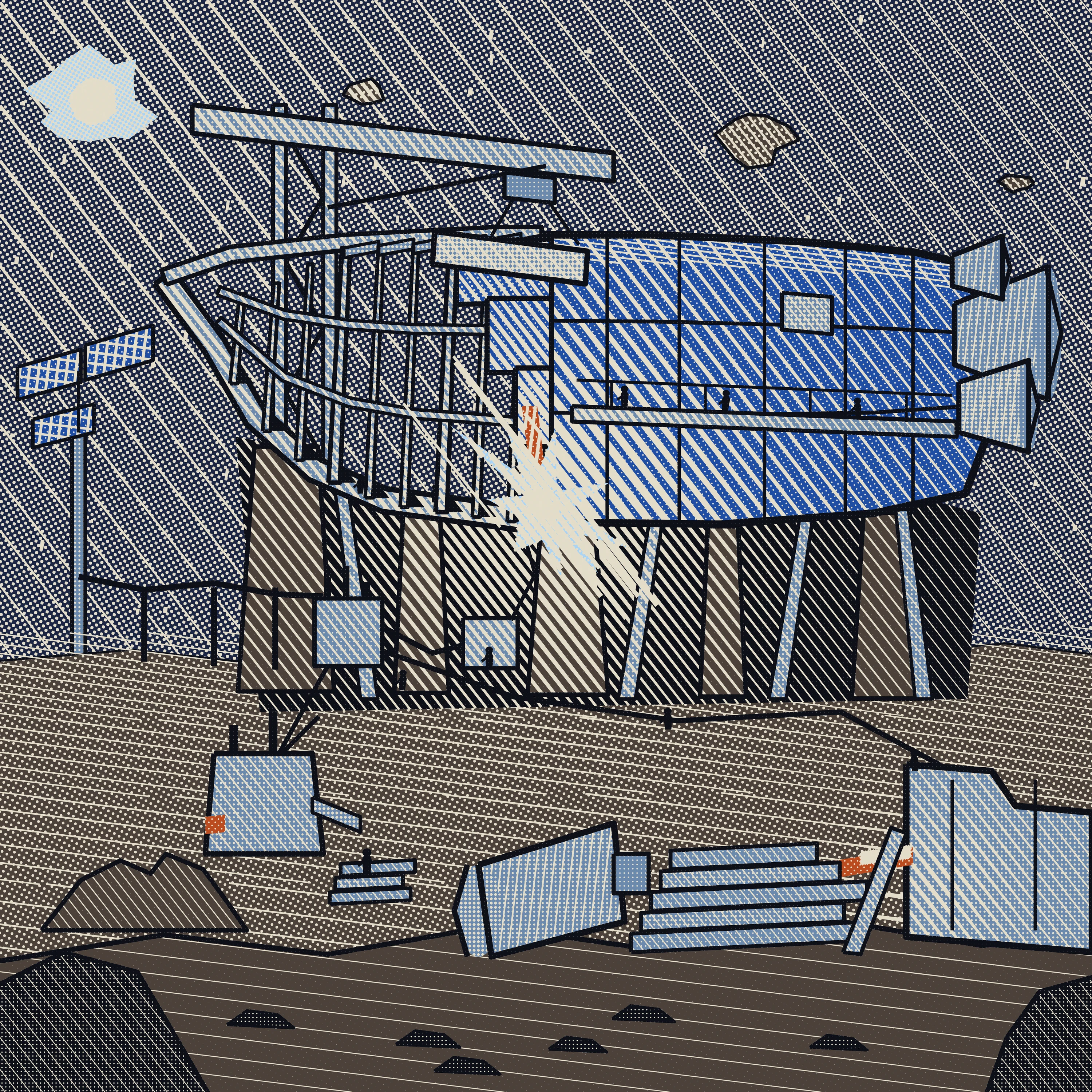
An artistic imagining, not real hardware. A woodcut style print of a ship hull standing broadside in a building slip cut into an asteroid. The forward half of the hull, on the left, is still an open cage: a heavy curved stem and keel with nine transverse frames rising from it, the frames getting taller aft, crossed by two longitudinal stringers and a walkway with two figures on it. The aft half, on the right, is closed in flat blue plating ruled into strakes and butt seams, with a hatch, a hanging staging where three more figures stand, and three unequal engine bells clustered at the stern. Three lapped plates step down at the joint between the frames and the plating, and one welding arc flares white at the keel there, throwing spiked light up into the cage and down over the cradle blocks below. The hull rests on five wide unequal blocks and four raking shores inside a black shadow. Above, an overhead crane carries a fresh plate on its hook. At the left a small collector array on a mast feeds a power line carried on posts to switchgear and out along a trunk cable to the welding rig, an ore kiln and a plate mill. In the foreground a tip of ore, a spare nozzle bell, stacks of rolled plate and a mill with a glowing slab. The whole plate is printed in halftone dots on bone paper and every light in it is cut as white lines on three fixed angles.
An artistic imagining, not existing hardware: a building slip cut into an asteroid, where a ship hull is being closed plate by plate over its bare frames on power drawn from a collector on the rim, with one welding arc at the keel doing the work the whole yard is wired for. M type asteroids are metal rich, and the Mond carbonyl process, an 1890 nickel refining route still used industrially, forms nickel carbonyl gas near 50 C and breaks it down near 230 C to lay down pure metal, which is why belt shipbuilding is usually imagined as a chemical and electrical business rather than a blast furnace. Image: poweringspace.com. Artistic imagining.