Image of the Day · 2026-05-08

The Grain of the Model

A simulation is nested state, so the hall shows its thinking as grain: one contour laid down per iteration, packed tight and hot where the model leaves the aisle, opening out to bare paper at the edge of what has been solved.
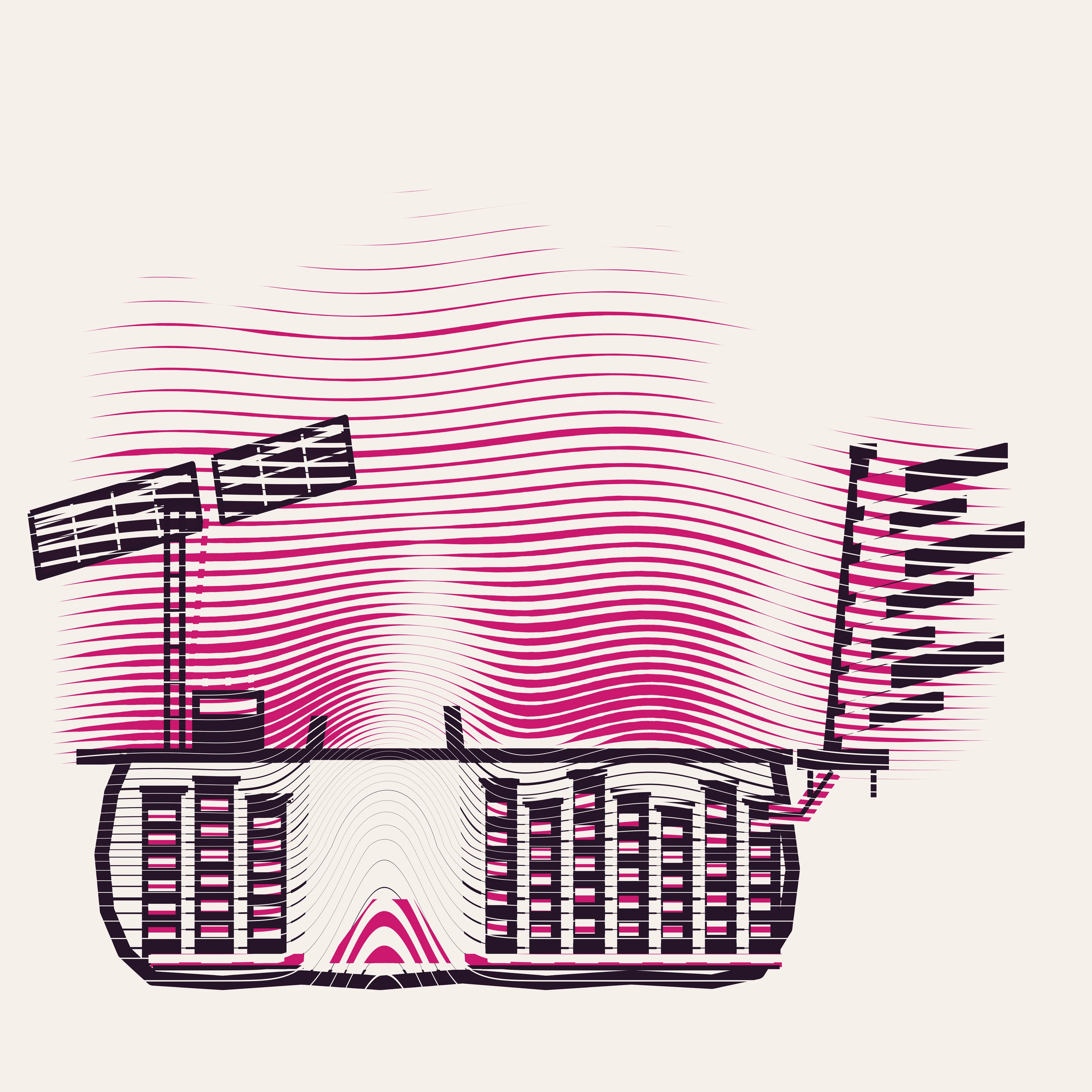
An artistic imagining, not real hardware. A square plate printed in two inks, magenta and dark plum, on warm near white paper, where every tone is made only by the thickness of one continuous family of flowing contour lines. Low and left of centre stands a long simulation hall shown in cutaway: three tall equipment cabinets on the left of a wide aisle and seven shorter ones on the right, each cabinet a dark flat shape carrying a stack of magenta slot bars, all of them standing on a magenta bus duct that runs the length of the floor. In the aisle between the two unequal ranks, a low magenta channel in the floor is the brightest source in the picture, and the light it throws leaves the hall as a tall wedge of bare unprinted paper rising through a gap in the roof deck. Out of that gap the model itself pours upward as about forty nested undulating magenta contours, packed tight at the aperture and opening wider and fainter as they climb, every sixth one struck heavier, until they fade to open paper well short of the frame. High on the left, two canted solar panels ruled with pale cell lines sit on a braced lattice tower, with a magenta conductor sagging down the tower into a switch house on the deck and a feeder dropping through into the hall. On the right, a magenta duct carries heat out of the hall's far end to a spine holding seven canted radiator fins of unequal length, each fin glowing magenta at its root.
An artistic imagining, not existing hardware: a simulation hall at the Sun-Earth L5 point spending its entire power budget on one model, printed so that the model is the grain of the plate itself, one flowing contour laid down per iteration and widening as it cools. L5 sits 60 degrees behind Earth along its orbit in continuous sunlight, and since essentially every joule a computer draws leaves it again as heat that can only be radiated away in vacuum, the fin stack on the right is as much a part of thinking as the racks are. Image: poweringspace.com. Artistic imagining.