Image of the Day · 2026-05-21

Colder Than the Dark

It has to be colder than the dark to see into it, so the shade does more work than the telescope.

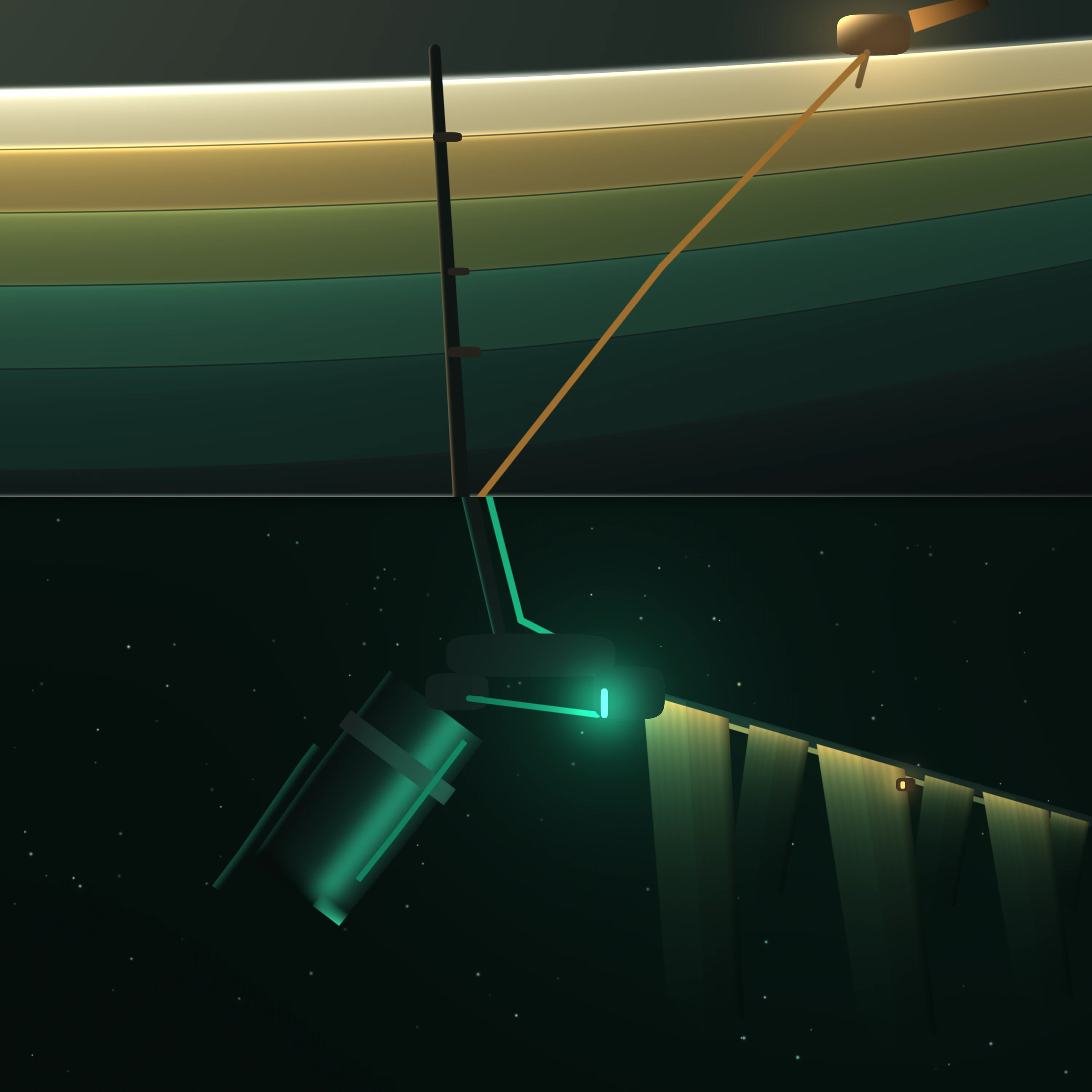
An artistic imagining, not real hardware. A square picture in deep petrol green, split across the middle by one hard horizontal cut, as though two photographs had been scissored apart and butted together. Above the cut, filling the top of the frame, is the underside of a five layer sunshade seen at a grazing angle from below: five long curved sheets fanning open to the right, each with a lit far edge, stepping in colour from a blown incandescent gold at the top through olive and sage to a green that is almost black at the fifth, with the sky beyond the first sheet milky with scattered light and holding no stars at all. A leaning mast rises through the stack, collared where it passes three of the sheets, and a thin amber power line runs down from a small sunlit power block at the top right corner. Both the mast and the power line visibly jog sideways where they cross the cut, and the power line changes colour there from amber to emerald. Below the cut everything is deep green black and full of sharp small stars. A horizontal service spine hangs there with a stout cylindrical instrument slung under its left end, aimed down and to the left into the darkest part of the frame: the tube is lit along its lower flank by a narrow green highlight, wrapped by one collar, clamped with a single cryogen line, shrouded on its upper side by a matte black baffle that overshoots the open end, and its mouth is a dark bore with one bright arc on the lower lip. A small block near the spine glows with a slot of intense pale green, the coldest looking thing in the picture, with a single pipe running from it to the instrument. From the right end of the spine a boom runs out and down to the corner of the frame carrying a supply manifold and six hanging plates of very unequal width and length, leaning at different angles and overlapping each other in depth. Each plate is amber where it meets the manifold, fades through pale yellow green, and goes to green black at its lower tip, and a soft green haze drifts off the near face of each one. One tiny warm lit doorway, a few metres across against plates hundreds of times its size, is cut into the flank of the plate field. No text, no lettering, no insignia. Nothing shown here exists.
An artistic imagining, rendered procedurally, of a deep space observatory that has to be colder than the dark it is looking into: a five layer shade takes the sun apart above the cut, and everything the machine cannot block is pumped out through the plate field below it, amber where the fluid arrives and black by the time it reaches the tip. The physics is real even if the vehicle is not: a passive multilayer sunshade at a cold parking orbit can hold roughly 360 K on its sunward face and about 40 K on the shaded side, an active cryocooler is needed to take an instrument the rest of the way down to single digit kelvin, and because there is nothing out there to conduct or convect into, every watt of that pumped heat has to leave as infrared from a radiator surface. Image: poweringspace.com. Artistic imagining.