Image of the Day · 2026-05-28

A Star With Handrails

A star kept running as plumbing: under a hundred metres of asteroid, the reactor is only the biggest thing in the plant room.
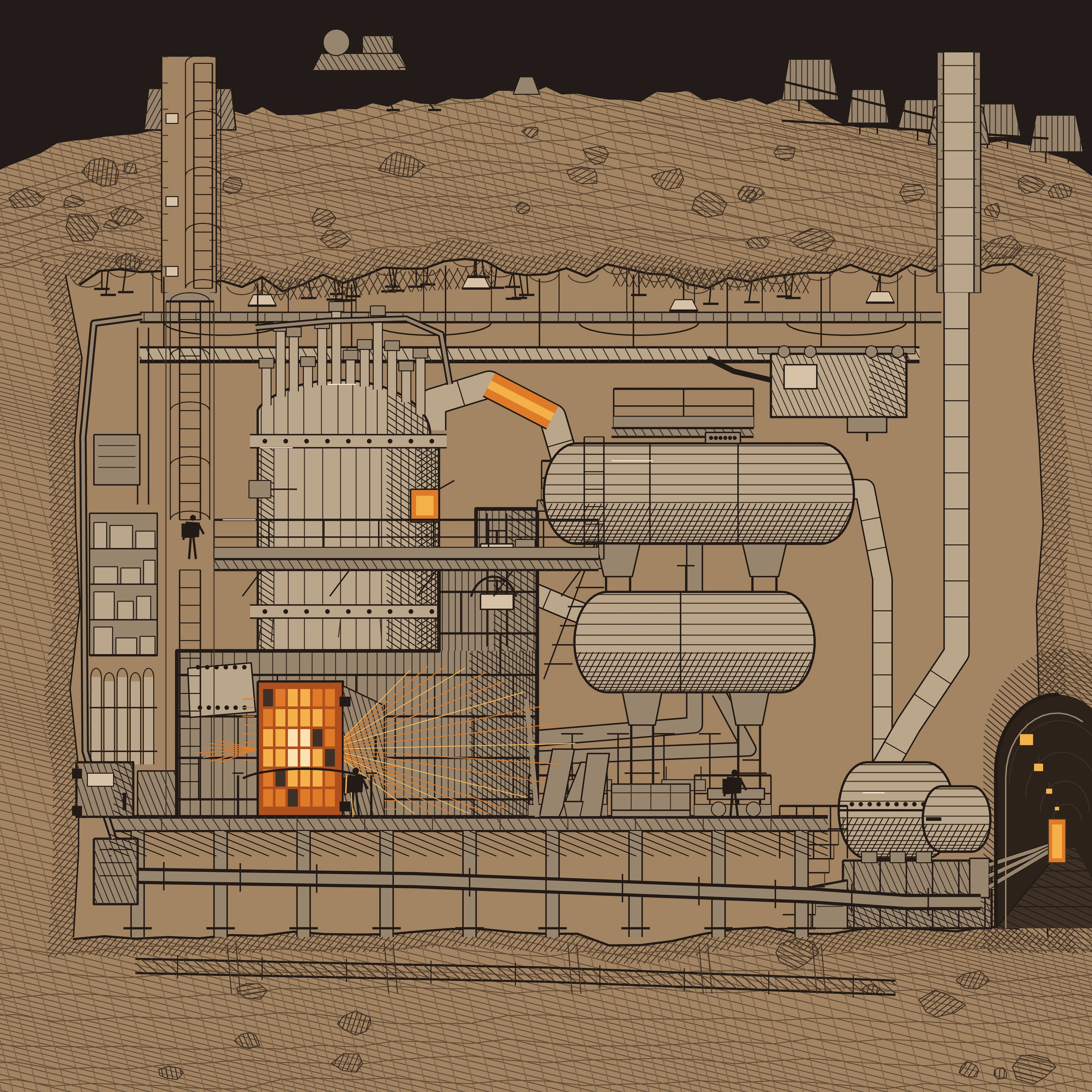
An artistic imagining, not real hardware. A plain orthographic section drawing, in dark brown line work on a flat mid ochre ground, of a nuclear plant built inside a hollowed out asteroid. Across the top of the frame runs a narrow band of flat black vacuum, and below it the convex limb of a small rocky body, with a squat crew lander on splayed legs, two small head houses over shafts, a survey monument and a row of unequal flat radiator panels standing on the surface. Under the surface is a thick band of hatched rock in section, drawn with bedding lines and angular breccia clasts and pierced by two lined shafts: a personnel shaft on the left with a caged ladder and small lamps, and a coolant riser on the right carrying a duct up to the radiator panels. The rock opens into a single excavated hall filling the middle of the frame, its scalloped ceiling carrying rock bolts, wire mesh panels, a cable tray on drop hangers, four working lamps and a crane rail. Left of centre stands the reactor: a stepped mass of shield blocks with coarse staggered coursing, and on it a squat cylindrical vessel with a domed head, two bolted ring flanges and a crowd of twelve control rod drive stand pipes of unequal height rising off the dome under a gathered cable loom. At deck level a shield door stands open on its hinges behind a chain barrier, and inside it a six by six grid of glowing fuel channel ends runs from deep orange to near white, five of the channels plugged and dark. Ruled orange rays fan out of the opening across the deck, and a single suited faceless worker stands beside it in silhouette. Two lagged pipes leave the vessel, one with a short length of lagging removed showing bare hot orange pipe, and run right into two horizontal heat exchanger drums of unequal size on saddle stands, the upper one carrying a walkway and handrail. Beyond them a steam line drops into a small turbine and alternator set on a hatched plinth on the lower floor, and from its terminal box three heavy bus bars run right into an arched tunnel bored through the rock wall, where a hatched roadway, ring beams and four crown lamps recede to a small lit doorway in the distance. A second heavy bus runs the other way along the undercroft beneath the steel deck, on cleats between stub columns, to a distribution board at the left wall, and a feeder climbs from that board to the ceiling tray that lights the hall. The hall is full of ordinary working evidence: handrails with kick plates, caged ladders, a parked charge machine stowed on the crane rail, spares racking, a bank of gas bottles, drip pans, a pallet of shield blocks, a wheeled trolley, a bucket, a hose hung in a shallow drape, lifted floor plates leaning against the shield, a bolted patch plate and drainage stains. A cut drain channel and core drill holes run across the rock invert below. Everything except the core, the small inspection port and the one unlagged pipe is drawn in browns.
An artistic imagining of a fission plant working inside a hollowed out asteroid, not real or planned hardware. The core glows through a shield door left open at floor level, its heat passes out through two exchanger drums to a small turbine set, and the current leaves on heavy bus bars down a bored tunnel toward whatever the rock is being kept warm and lit for. Image: poweringspace.com. Artistic imagining.