Image of the Day · 2026-05-29

Ten Thousand Emitters, One Shaft

Ten thousand emitters hold perfectly still so that one sail can leave in a straight line.

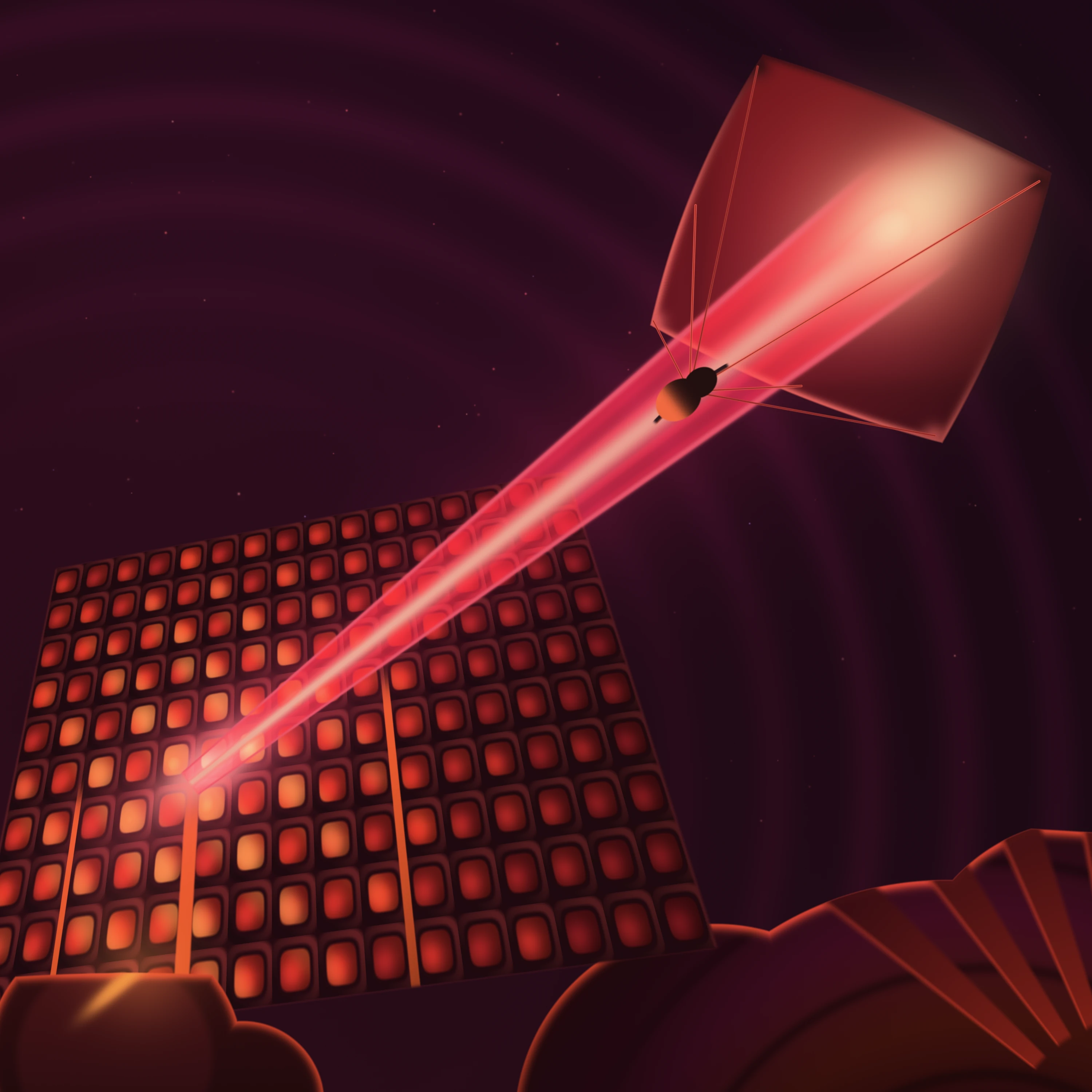
An artistic imagining, not real hardware. A square picture in deep oxblood and hot crimson, almost black at the top right and glowing at the bottom left. Filling the lower left half of the frame is an enormous flat panel seen at a steep angle, tilted away from the viewer and running off the left and bottom edges: it is ruled into a grid of one hundred and sixty identical square emitter apertures, sixteen across and ten deep, each one a rounded pad modelled with its own soft highlight and its own shadow, and each one lit from within so the field glows in a slow wave from pale apricot near the lower left to dull brick red at the far corners. The panel carries a raised rail around its edge and three bright orange conductor lines of unequal width that climb its face along the grid, the widest of them rising from a dark cowling at the bottom left corner, whose glowing slot is the only other light source in the picture, and ending at a small blinding node partway up the panel. From that node one straight shaft of light leaves at about forty five degrees. It has hard edges, two bright rails, a pale pink core and faint lengthwise striations inside it, and it stays a shaft rather than spreading into a glow: it crosses the entire grid diagonally, passes out beyond the panel's upper right corner and travels on across empty space to the upper right of the frame. There it lands, off to one side of centre, on a large square membrane sail tilted in three quarter view, whose four edges bow very slightly outward and whose four corners carry dark cleats. The membrane is bright pinkish gold where the beam strikes it and falls away to deep red at its far corners, with a lit boom along its near edge. In front of the sail, silhouetted against the beam, hangs a small dark payload canister on a slim cross boom, held by six taut shroud lines that fan out to the corners and edges of the sail. Along the bottom right of the frame is a dark curved hull banded with concentric ribs, with a fan of radiator plates spreading from its right side, each plate lit along its leading edge and tipped with a thin cold violet rim. The open upper left is a broad magenta wash crossed by faint concentric arcs spreading out from the beam node, with a scatter of small warm stars. No text, no lettering, no insignia. Nothing shown here exists.
An artistic imagining, rendered procedurally, of the transmitting end of a beamed power link: a phased array of many identical emitters holding perfectly still in ranks while the one shaft they sum to crosses its own field and pushes a lightsail away. The physics is real even if the station is not, since a perfectly reflected beam delivers about 6.7 newtons of thrust for every gigawatt landed on the sail, and a field of small phased apertures can hold that beam collimated far past what any single emitter of the same size could manage, which is why a launch transmitter is a disciplined grid rather than one big dish. Image: poweringspace.com. Artistic imagining.