Image of the Day · 2026-06-01

Casting Ceres

They are casting Ceres itself, section by section, and every section costs a crucible-load of power.

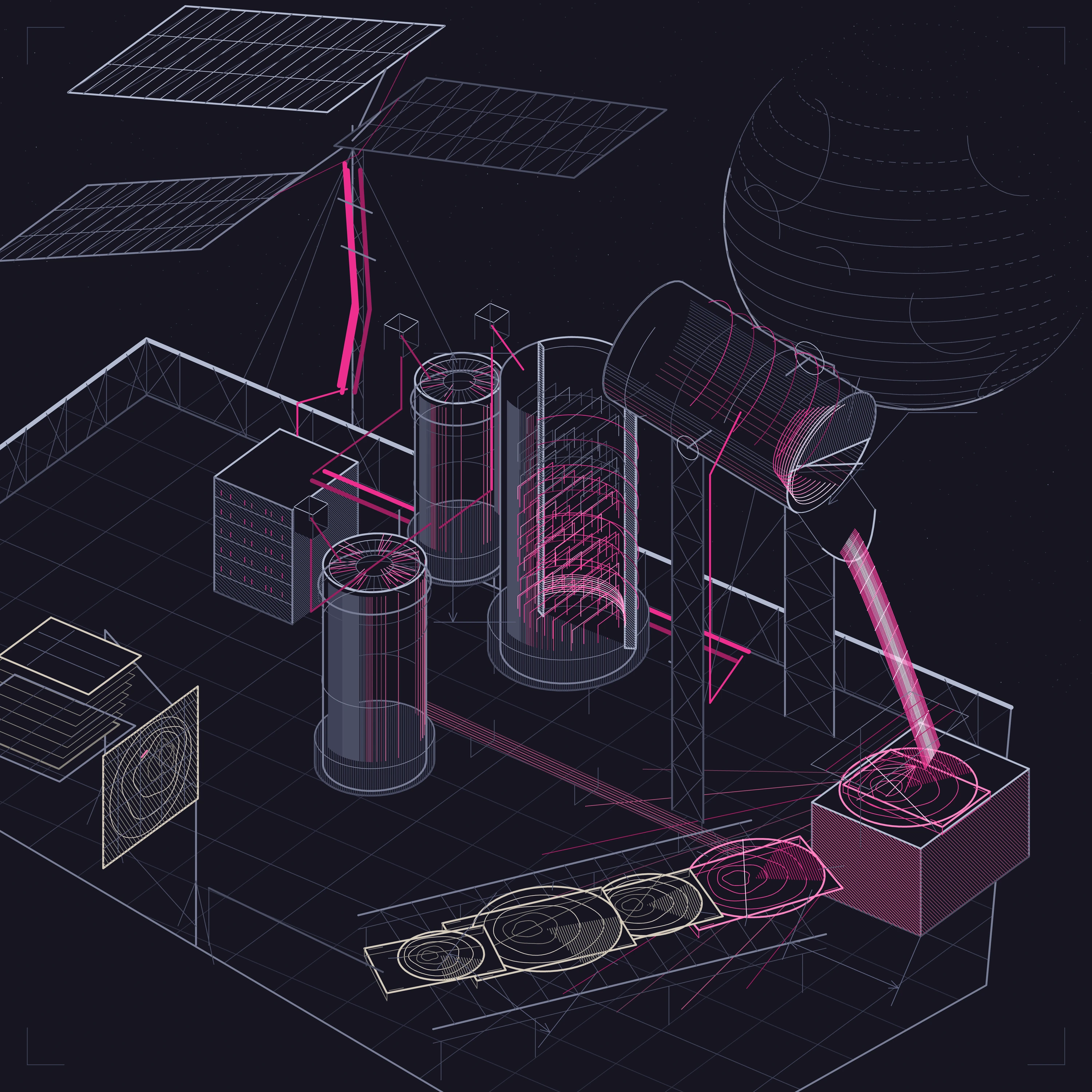
An artistic imagining, not real hardware. A dark line-work plate, drawn entirely in ruled pen strokes of three weights on a deep indigo ground, showing a casting deck in orbit about Ceres in axonometric projection, the works running from the upper left corner down to the lower right. At the top left three large lattice collector wings on a guyed mast are cropped by the edge of the sheet; three heavy magenta conductors run down the mast in dead straight runs with cleats to a switchgear cabinet whose front carries five shelves of small magenta indicators, and a magenta busbar runs on along the deck above the machinery, dropping once into the head of each vessel. Three standing crucibles occupy the centre: two are closed, with card slots radiating around their open heads and a few of the slots lit magenta, and the tallest has its near quarter cut away in the manner of a catalogue half-section, its two cut faces hatched at forty-five degrees, showing eight tiers of card cages inside, the lower five incandescent magenta and the upper three cold grey, with a dense band of hot rules at the working level and live induction turns wrapped round the wall that remains. To the right a fourth crucible hangs on trunnions in a latticed steel tower, tipped past horizontal with a refractory cover closing the upper half of its mouth and a bail bar across it; a bright stream of magenta and near white hairlines falls from its beak in a shallow arc into an open mould box, where the section being cast glows as a contour map on a rectangular plate. A roller table carries four finished plates across the near deck, each a different parallel cut through the same body, drawn as a circular outline with irregular off-centre contours inside it and one sector hatched, cooling from hot magenta at the mould end to bone white at the far end; a fifth plate stands on edge in an inspection jig at the left under a reticle of unequal cross rules, and a low stack of uncast blanks waits beside it. Ceres itself hangs in the upper right, drawn as its own family of latitude sections, bright rules on the sunlit limb thinning into rows of dots across the terminator, with broken crater arcs. A faint ruled construction lattice covers the whole deck and runs on past the machinery into bare deck; dimension lines with open arrowheads and no numerals sit on the drawing, and trim marks stand at the corners. No text, no insignia, no filled areas, no shading; nothing shown exists.
An artistic imagining, rendered procedurally, of a model foundry in orbit about Ceres, where computation is handled the way a mill handles metal: charged into crucibles, run until it is molten, tipped out, poured, and drawn off as cast plate carrying one exactly known section of the body being modelled. Sunlight at Ceres' mean distance of about 2.77 AU is only some 13 percent as strong as at Earth, which is why the collector wings feeding the crucibles have to be that large; the foundry, its spun casting deck and the casting of a simulation as physical plate are speculation. Image: poweringspace.com. Artistic imagining.