Image of the Day · 2026-06-10

The Sun Divided Fifteen Ways

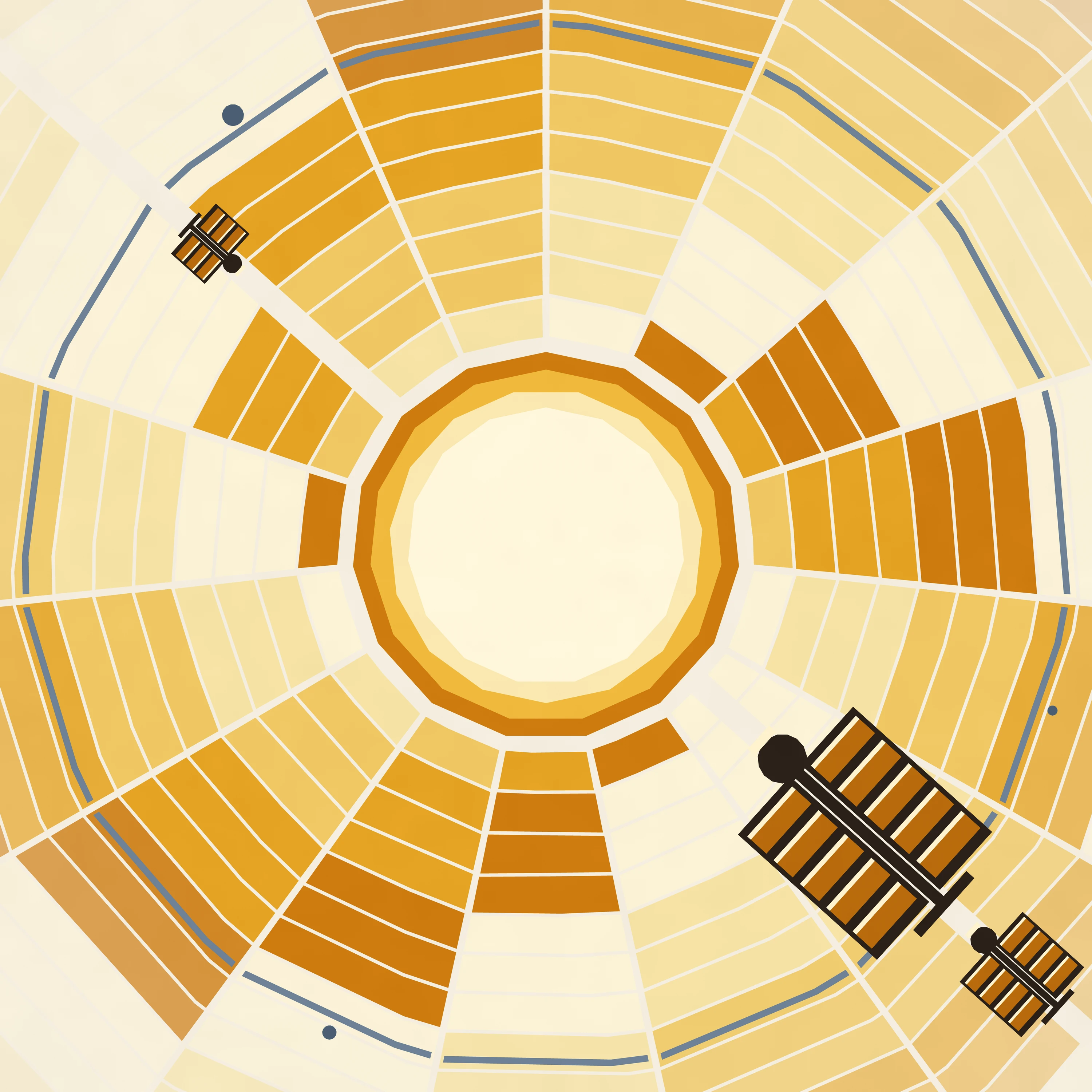
Seen from over its pole the sun stops being a disc and becomes a system — fifteen rays of gold — and the station falls straight through the middle of it, drinking one.

An artistic imagining, not real hardware. A flat geometric composition on warm bone paper, built entirely from straight-edged filled polygons. At the exact centre sits the sun, drawn not as a circle but as a large fifteen-sided polygon in four concentric flat bands: a deep amber rim, a mid gold band, and a pale near-white interior. Around it a radial field of seventeen concentric rings is cut into fifteen equal wedges, and every resulting cell is filled with one of five flat golds chosen by a fixed rule, so broad rays of deep amber alternate with pale ones and step one sector sideways every third ring, making a slow spiral of light. Narrow lines of bare paper are left between every cell, so the underlying grid reads as a web of fine radial and concentric reveals; toward the corners the golds dissolve step by step into the paper itself. A thin segmented slate-blue ring crosses the outer field, carrying three small slate polygons. One clear corridor of bare paper runs from edge to edge across the square on a diagonal, passing behind the sun. Three spacecraft of decreasing size stand in that corridor: each is a dark boom with a fifteen-sided hub at its sunward end, a cross plate at its far end, and two rectangular wings carrying rows of deep amber panels, every panel with a pale strip along the edge that faces the sun. The largest sits at the lower right, its wings about as long as the sun is wide. No text or lettering appears anywhere.
An artistic imagining of a solar-power observatory in a steep polar orbit around the sun, drawn in the manner of concrete art: the whole picture is the visible form of one rule, a fifteen-fold division of the circle in which even the sun is refused its circle and built as a fifteen-sided polygon. Seen from over the pole the sun becomes a system of gold rays rather than a disc, the bare diagonal corridor is the station's orbit drawn by absence, and the three craft standing in it are one observatory at three points of a single pass — spacecraft really have flown steep solar-polar trajectories (Ulysses reached roughly 80 degrees heliographic latitude, and Solar Orbiter has climbed past 30), where sunlight arrives unattenuated and is never once eclipsed. Image: poweringspace.com. Artistic imagining.