Image of the Day · 2026-06-13

Noon Feeds Midnight

The Moon's equator drawn the way a transit map draws a route - dead straight through the terminator, noon loaded on at one end and coming out as light at the other.
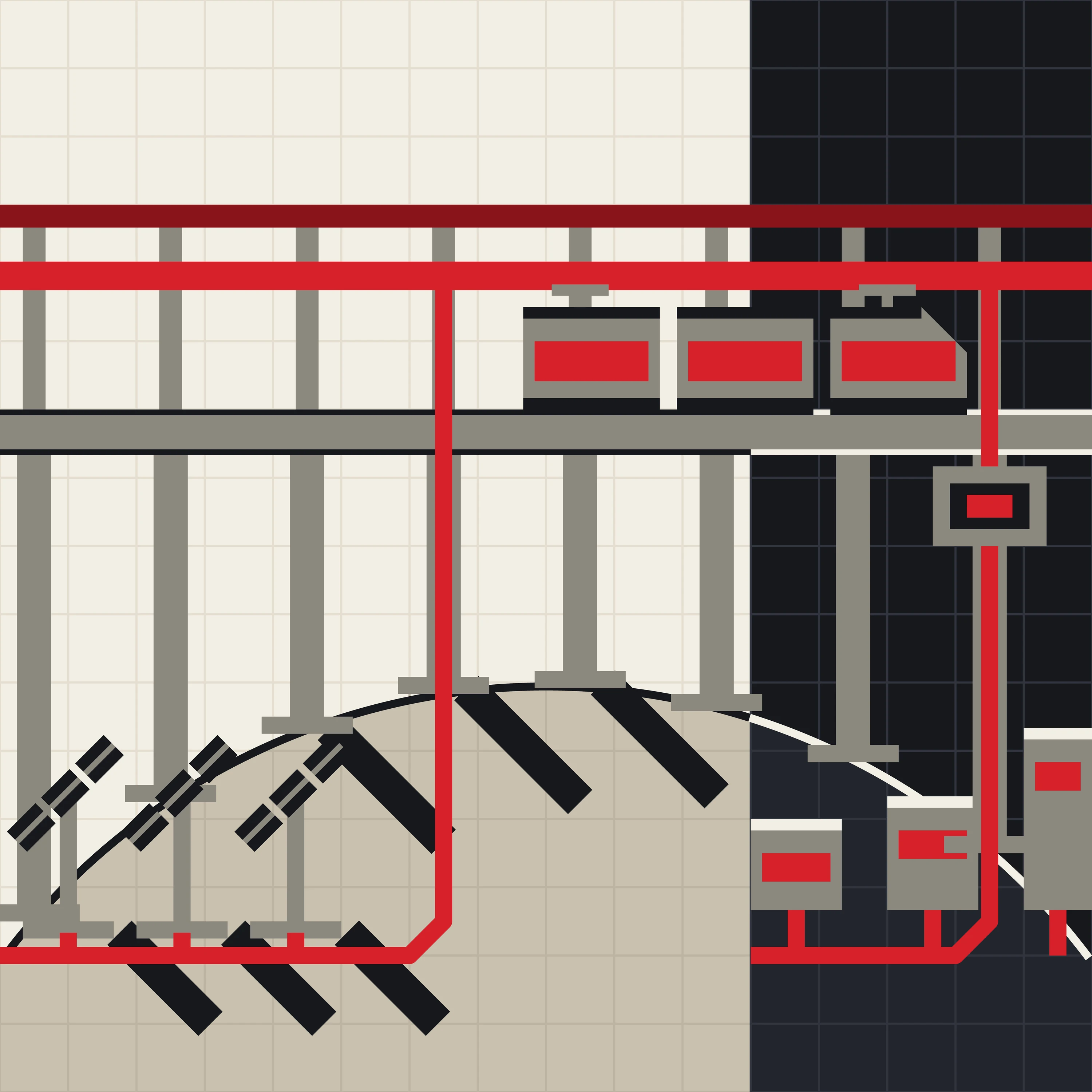
An artistic imagining, not real hardware. A flat-plane transit-diagram poster on a light warm paper field ruled with a faint square grid. The right-hand third of the sheet is a single flat rectangle of near-black night, divided from the sunlit left by one dead-straight vertical line on a grid column; the curved limb of the Moon crosses the lower half, pale grey where the sun is on it and dark beyond the line. A steel viaduct runs the full width without a bend, bleeding off both edges: eight tall pylons on the grid, a deck ruled in black on the day side and in white on the night side, and above it two conductors of constant weight - a deep oxblood return line and a bright red live line. A three-car train with red-lit windows rides the deck straight through the boundary, its leading car chamfered at forty-five degrees, two pantographs touching the red line. On the sunlit left, three ranks of dark angled solar panels on steel masts throw hard black forty-five-degree shadows across the regolith beside the pylons' own; red take-off stubs drop from them to a red ground bus that bleeds off the left edge, turns up a pylon and climbs to the live conductor. On the dark right, one red drop falls from the same conductor through a small switchgear box slung under the deck to a second red ground bus, which raises three low steel habitat blocks with white roof rules and red-lit interiors. Purely procedural flat geometry, no gradients, no text, no insignia; nothing shown exists.
An artistic imagining, rendered procedurally, of a power-and-transport rail run right around the Moon's equator, drawn the way a transit map draws a route: the world curves away underneath but the line does not bend, and the current it carries is loaded on in the sunlight and comes out as light on the far side of the terminator. The Moon's day really does last about 29.5 Earth days, leaving an equatorial base roughly fourteen Earth days in darkness at a stretch; wiring noon to midnight along a circumequatorial rail is speculation. Image: poweringspace.com. Artistic imagining.