Image of the Day · 2026-06-20

The Second Sun

The swarm draws a second sun on the Venusian sky, and pours the whole drawing into one small machine.

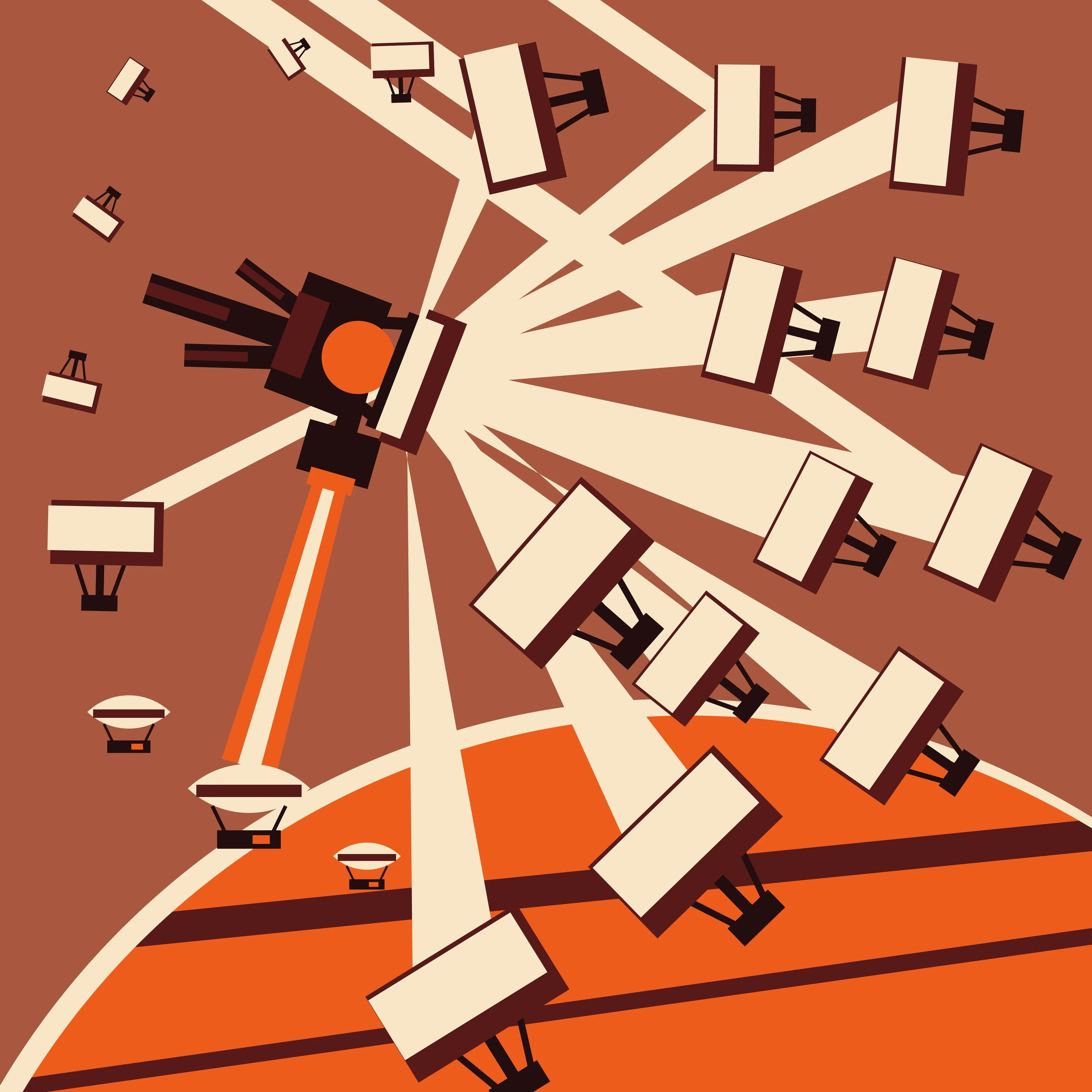
An artistic imagining, not real hardware. A flat poster square in five reds. The field is brick red; across the bottom rises the huge vermilion curve of Venus, edged with a thin cream line of sunlit limb and crossed by two dark oxblood cloud bands. Scattered across the field are eighteen flat cream rectangles seen at varied tilts, each one a mirror carried on a short black boom with a small black equipment box behind it. Thirteen of them throw hard-edged tapering wedges of cream light inward, and all thirteen wedges converge on one point left of centre, where a compact black machine stands: a blocky hull, a bright vermilion circle of a boiler, a flat cream absorber plate turned to face the incoming light, and three black radiator fins fanned out behind. Three constant-width cream bands enter from the top edge and end on mirrors, showing where the sunlight comes from. Below the machine a boom points down and emits one straight vermilion lance with a cream core, which drops to a line of three cream lens-shaped aerostats hanging over the planet's cloud tops on black gondolas. Nothing is shaded, outlined or blended. No text, no insignia; nothing shown exists.
An artistic imagining, rendered procedurally, of a solar power station in low Venus orbit fed by a swarm of free-flying mirrors: sunlight passes the station untouched, strikes the shoal of mirrors flying beyond it, and comes back as thirteen converging wedges onto one absorber plate, leaving again as a single lance of power dropped to the works riding the cloud tops. Sunlight at Venus really is close to twice as strong as it is at Earth, and aiming many flat steerable mirrors at one raised receiver is ordinary working technology in ground-based solar power towers; an orbital mirror swarm and a cloud-deck receiving station are speculation. Image: poweringspace.com. Artistic imagining.