Image of the Day · 2026-06-28

Light Made Edible

Light goes in raw and comes out edible.

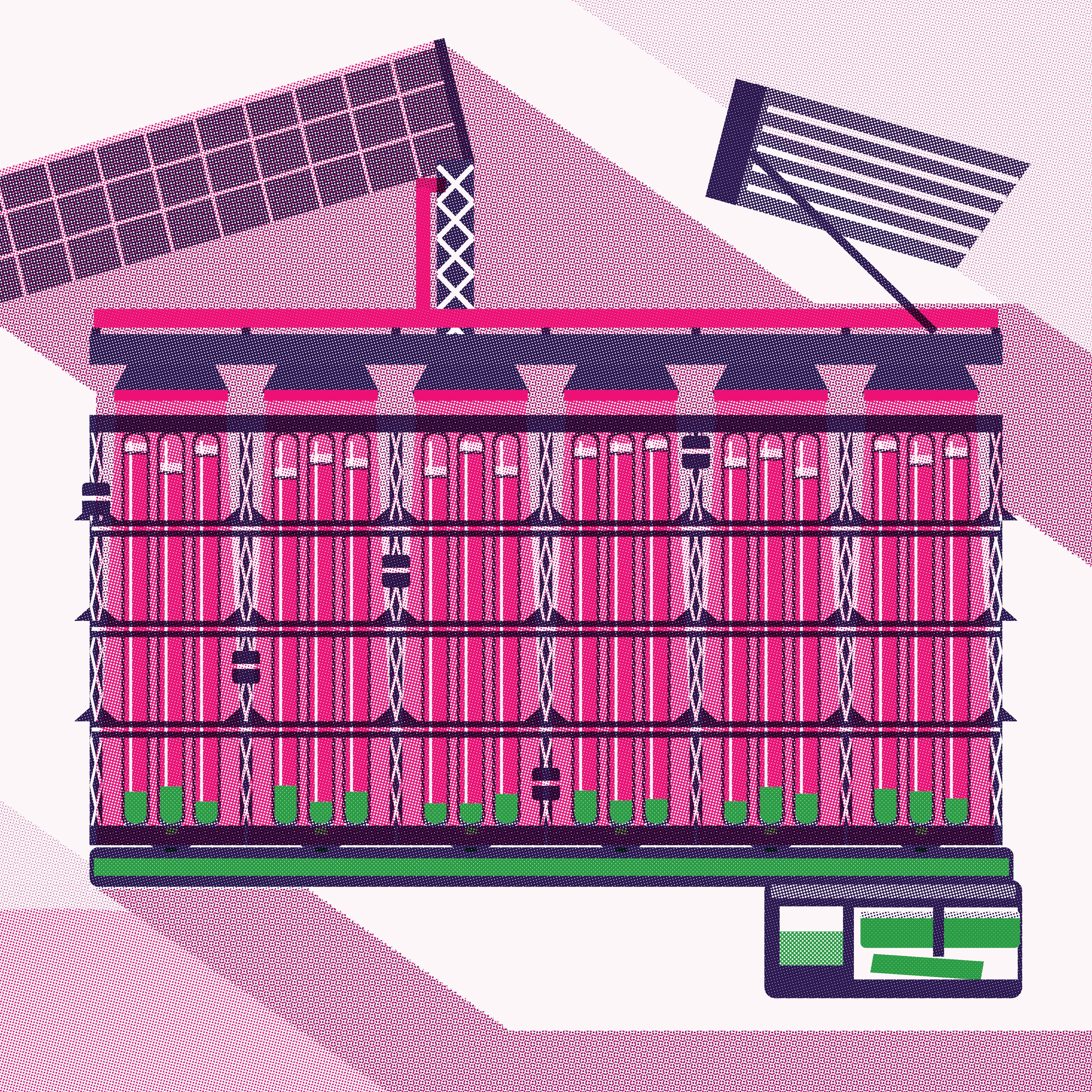
An artistic imagining, not real hardware. A square poster printed entirely as halftone dots in three inks on a pale warm stock: hot magenta, deep violet and a single biomass green. A hard edged band of bare stock crosses the picture from the upper left, the light of an unseen sun, leaving two softly screened corners outside it. Filling the centre is a wide standing bank of eighteen tall glass culture columns, grouped three to a bay across six bays and crossed by four horizontal service decks, so the whole machine sits on one strict orthogonal grid. Each column is a violet walled tube filled almost to the top with dense magenta culture; each carries a narrow bare white specular stripe, each liquid level sits at its own slightly different height, and each column has a plug of settled green biomass banked at its foot. Above the bank runs a bright magenta power bus and a violet lamp rail carrying six downward facing luminaires, and six hard cones of magenta light spread from them across the columns. A long solar wing, subdivided into cells, runs off the top left corner and feeds a braced mast and one hot magenta conductor down into the bus; a tilted slotted radiator plate sits in the shaded upper right corner on a thin boom. Below the bank, a green filled harvest trunk runs the full width and enters a violet press block at the lower right, where a ribbon of green cake is extruded through a cutter and one cut slab lies on the rack beneath it. The whole works throws one long hard edged shadow down and to the right across the field, with thin bands of light leaking through the gaps between the decks. No text, no insignia, no lettering; nothing shown exists.
An artistic imagining, rendered procedurally, of an orbital algae works: a photobioreactor farm whose entire job is to turn electricity into calories, its eighteen culture columns held under grow lamps until the biomass settles, drained into a harvest trunk and pressed into edible cake at the end of the line. Chlorophyll really does absorb blue near 450 nm and red near 660 nm while reflecting green, which is why real horticultural lamps are built from red and blue emitters and why grow rooms look this shade of magenta, and microalgae have been studied for decades as closed loop life support crops; a works of this size in orbit is speculation. Image: poweringspace.com. Artistic imagining.