Image of the Day · 2026-08-23

Some Are Nearly Out

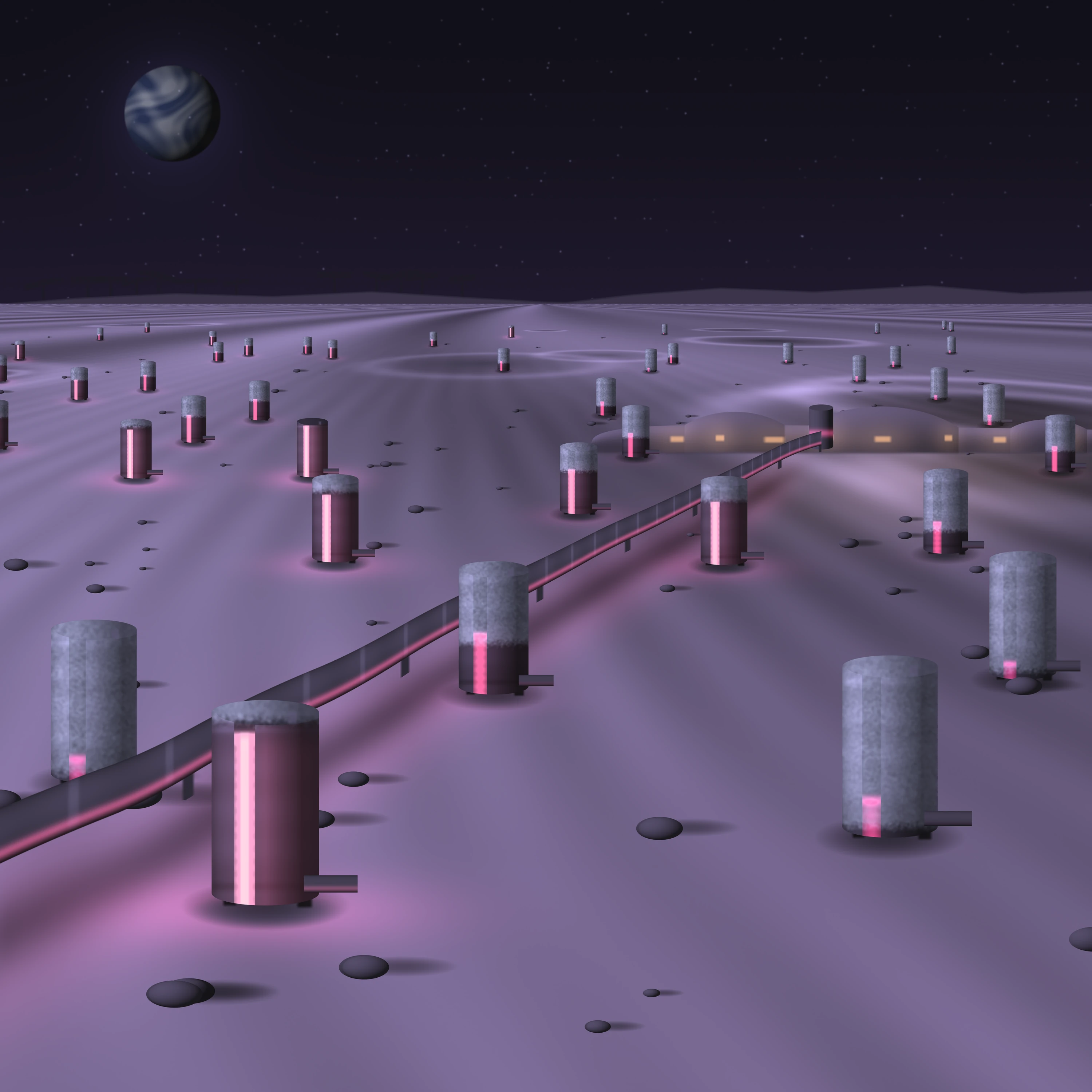
Fourteen days of night, and the field wears its charge on the outside: the fresh ones are lit to the shoulder, the spent ones are frosted to the ankles, and some are nearly out.

An artistic imagining, not real hardware. A violet lunar plain at night, seen from a low rise, scattered with dozens of identical squat cylindrical heat stores standing on three short feet. Each store carries a narrow recessed channel down one side that glows from the bottom up, and the height of that glow differs from unit to unit: the nearest store on the left is lit almost to its shoulder in hot rose and white, others are lit only to the knee in duller plum, and several are dark with pale frost crept most of the way down from their capped tops. A lagged trunk duct runs on short stanchions from the lower left, curving back across the plain with a warm seam glowing along its underside, and lands on a small receiver drum at a long low regolith berm on the middle right, whose face carries a row of small warm lit apertures and whose skyline shows a canted radiator fin and two slim masts. Low mounded boulders and shallow crater rims model the ground, a row of dark idle collector masts stands on the ridge at the left, and a dim gibbous Earth hangs in the upper left of a deep violet star field.
An artistic imagining, not existing hardware: a field of thermal heat stores on the Moon partway through the fourteen day night, each one wearing its state of charge on the outside, so a glance across the field reads as a census of how much of the day is left. The lunar night at low latitudes really does run about 354 hours, and thermal wadis - masses of sintered regolith charged by sunlight and drawn down after dark - are a real concept studied for keeping surface hardware alive until sunrise. Image: poweringspace.com. Artistic imagining.