Skip to content
Power in space · Generation, transmission, storage, use · Government and first-party sources
poweringspace
  • Home
  • Image
  • Analysis
  • Generation
  • Transmission
  • Storage
  • Use
  • About
Archive

Image of the Day

Every daily image published so far, newest first. Each is an artistic imagining of power in space, not a photograph of existing hardware.

All images

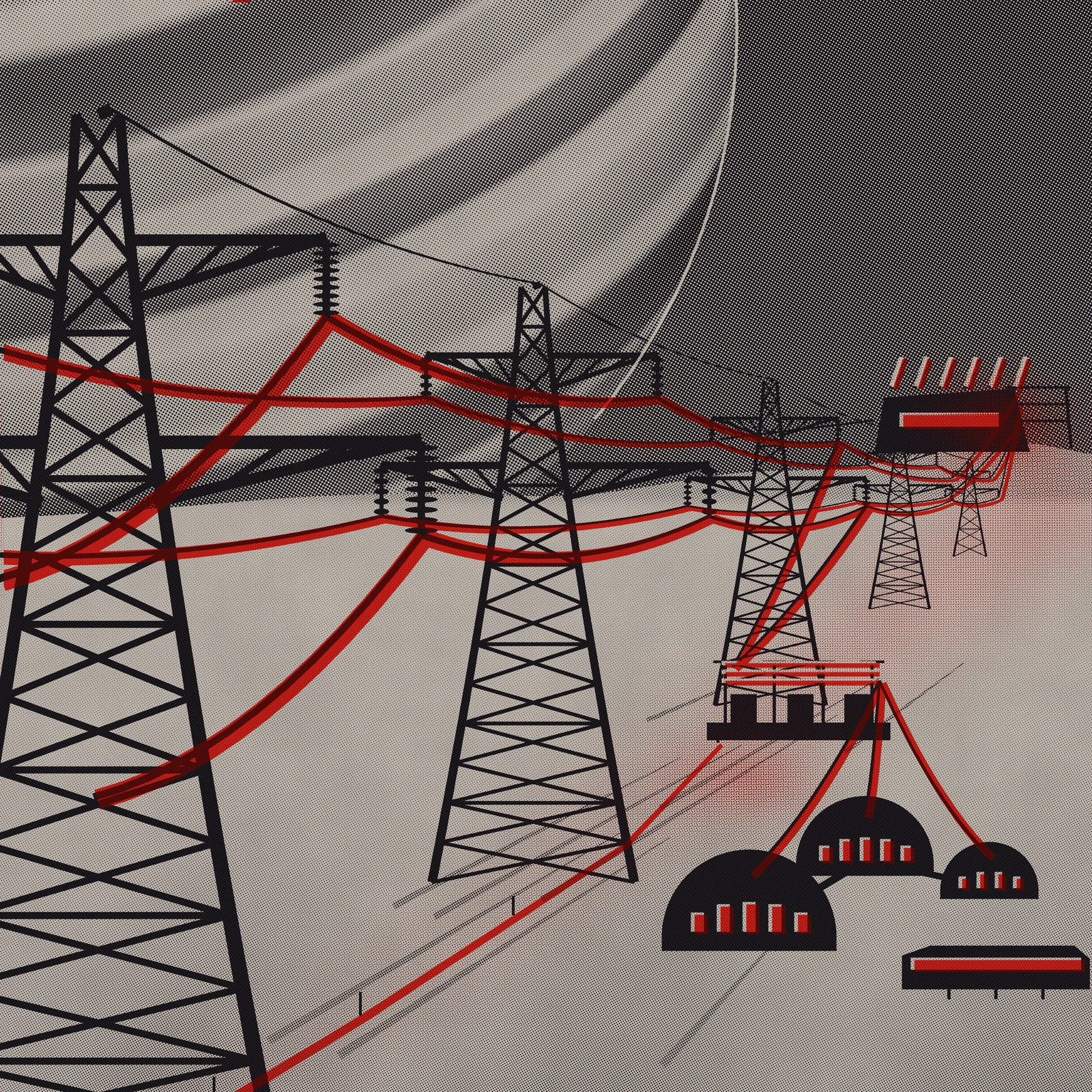
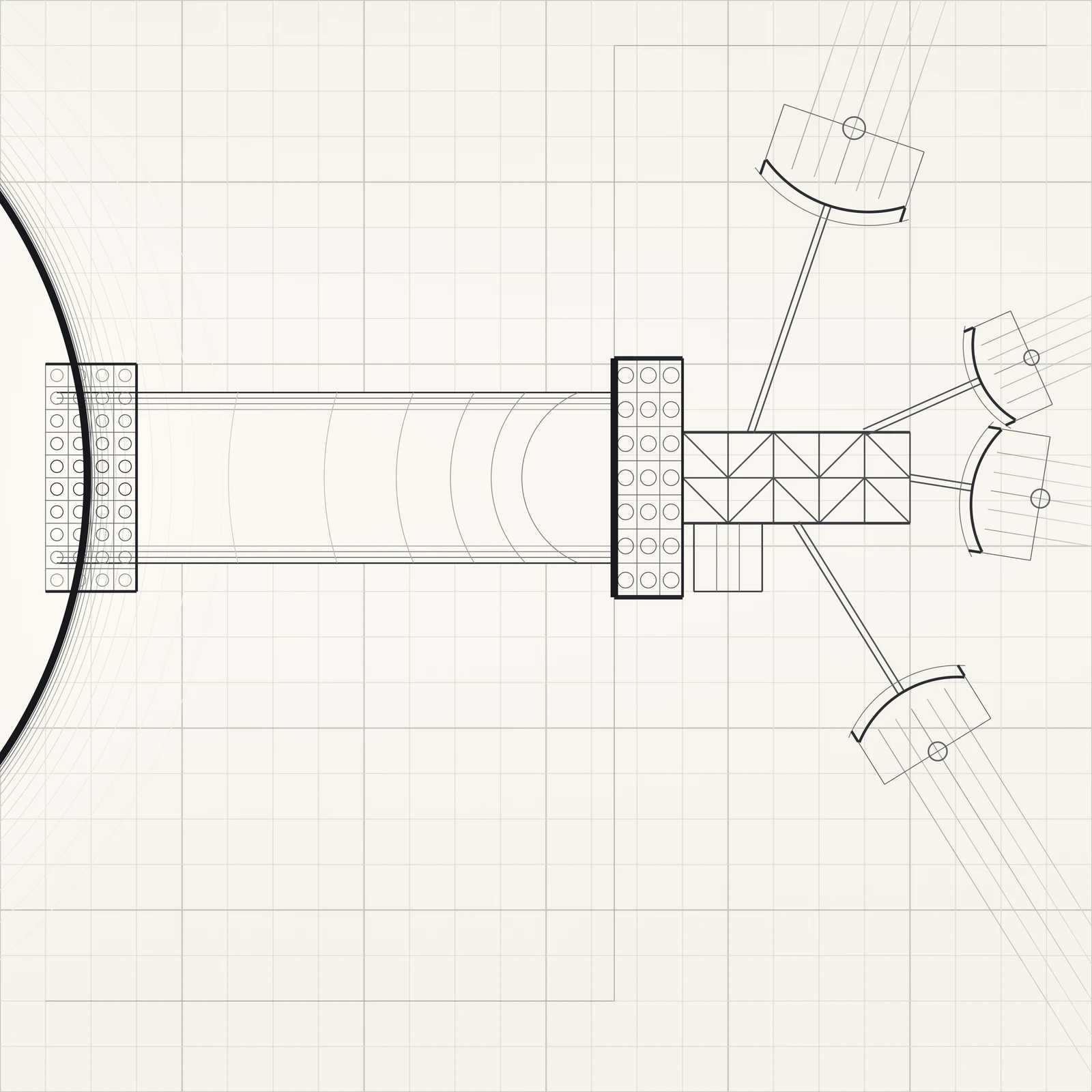
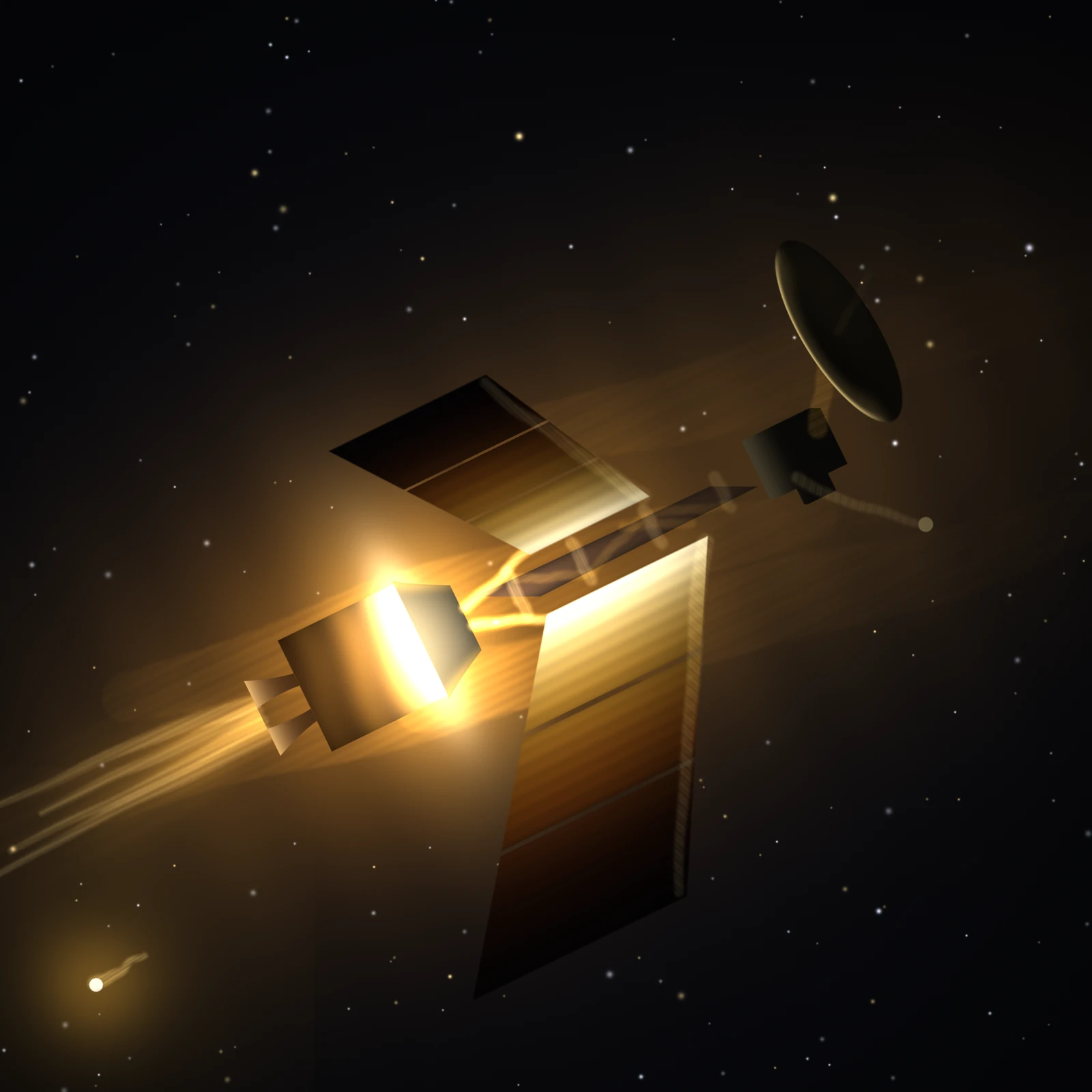
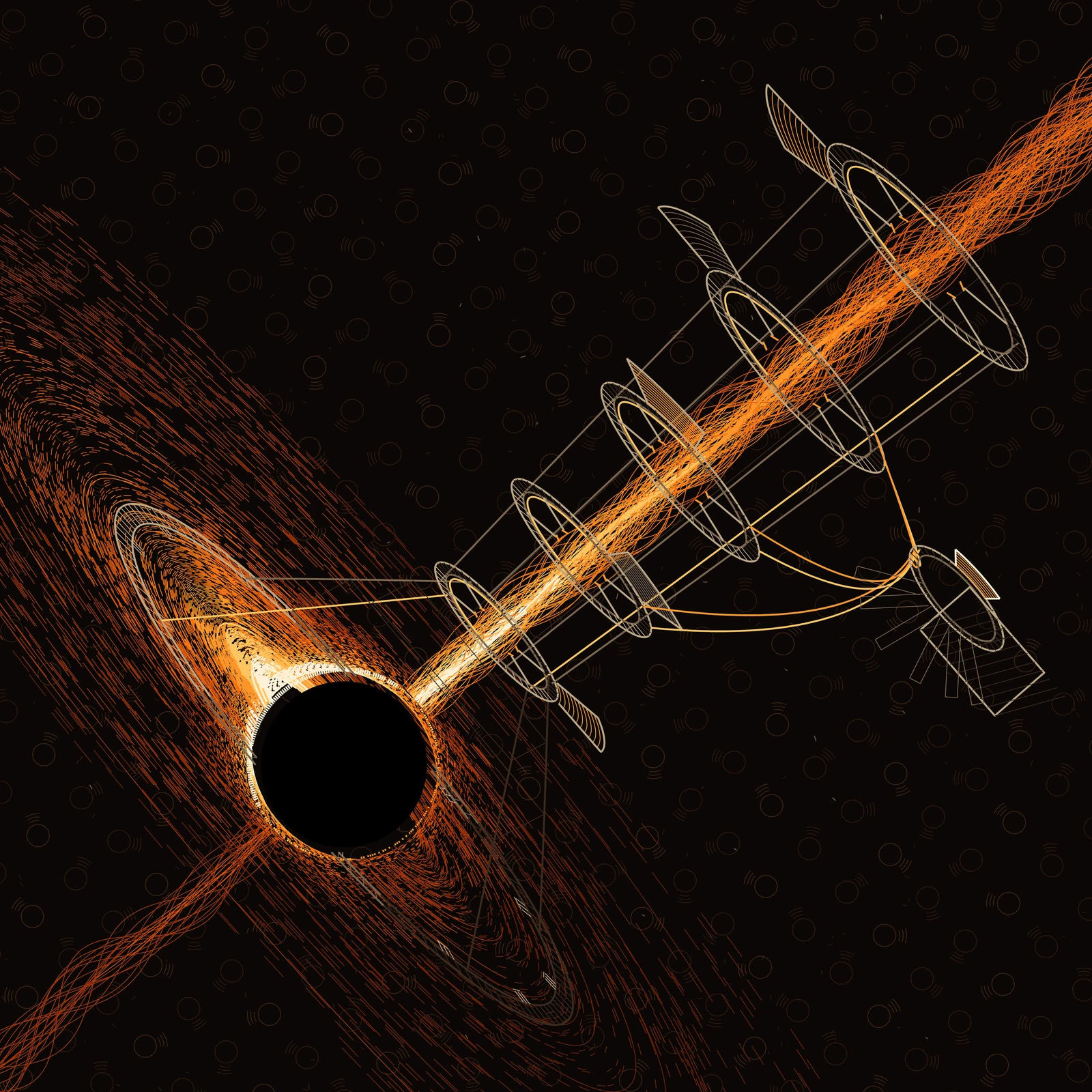
An artistic imagining, not real hardware. A flat geometric composition on warm bone paper, built entirely from straight-edged filled polygons. At the exact centre sits the sun, drawn not as a circle but as a large fifteen-sided polygon in four concentric flat bands: a deep amber rim, a mid gold band, and a pale near-white interior. Around it a radial field of seventeen concentric rings is cut into fifteen equal wedges, and every resulting cell is filled with one of five flat golds chosen by a fixed rule, so broad rays of deep amber alternate with pale ones and step one sector sideways every third ring, making a slow spiral of light. Narrow lines of bare paper are left between every cell, so the underlying grid reads as a web of fine radial and concentric reveals; toward the corners the golds dissolve step by step into the paper itself. A thin segmented slate-blue ring crosses the outer field, carrying three small slate polygons. One clear corridor of bare paper runs from edge to edge across the square on a diagonal, passing behind the sun. Three spacecraft of decreasing size stand in that corridor: each is a dark boom with a fifteen-sided hub at its sunward end, a cross plate at its far end, and two rectangular wings carrying rows of deep amber panels, every panel with a pale strip along the edge that faces the sun. The largest sits at the lower right, its wings about as long as the sun is wide. No text or lettering appears anywhere. 2026-06-10 The Sun Divided Fifteen Ways An artistic imagining, not real hardware and not a plan. A Dada-style photomontage on a near-black plum field, printed entirely in halftone dots with no flat areas anywhere. Filling the lower left and bleeding off two edges of the frame is an enormous banded gas giant, its cloud belts alternating hot magenta and deep wine and its edge burning bright; a large pale oval storm has been cut from another page and pasted onto its face. Clamped on the giant's edge is a heavy chamfered machine block striped with steel and magenta windings, its cream contact shoe pressed against the planet and throwing short white sparks where it touches. Two smaller copies of the same clamp, at about half and a quarter of its size, grip the edge further round. A railed ring runs out from behind the planet and right across the top of the frame like a ladder, two hot rails with cross-ties between them; three round moons at wildly different sizes ride it, each wearing a steel contact bar, and a few small machine units ride it with them. Thick cream cables gather from the clamps into one trunk and run down to the right, where a coil pack of alternating magenta and cream windings stands between two dark cheek plates above a ribbed drum on legs, and a single conductor leaves the drum and exits the right edge of the frame. The same planet appears a second time near the top left at a seventh of its size with its scissor edge still showing, thin magenta flux lines arc away from the giant's upper edge, and a dark slab in the top right is enlarged until its own printing screen has become the picture. The whole image is cut into eleven horizontal strips of unequal height, each printed at a different screen ruling and angle and slid sideways from its neighbours, so every form steps at every seam. No text, lettering, insignia, or figures appear anywhere. 2026-06-09 Jupiter Under Load An artistic imagining, not real hardware. A wide line drawing on a warm mid-grey stone field, made only of straight lines, circular arcs and round dots in dark pine green, bright green and a little amber. The picture is organised in horizontal bands. Along the top, a heavy green power line runs edge to edge and drops thin feeders into four long horizontal wires from which about fifty round vessels hang in three sizes, each drawn as a ring with an inner liner, hoop bands and a horizontal fill line, many of those fill lines bright green. Across the middle stands a row of galley machines on one dead-straight heavy line that crosses the whole picture. From the left: a funnel hopper over a narrow column of stacked half-arcs; a boxed mill with a spoked wheel and a graduated standpipe; then an enormous octagonal pressure vessel whose circular door fills most of the height of the row, ringed by concentric circles, eight heavy locking dogs, a bright green seal ring and an octagonal centre hub, with one small amber sight glass set off to one side and a green relief pipe rising from its top through the hanging vessels; then a range with five inset hobs each carrying a small amber point, a wide amber oven arc below the counter line and a large angled extraction hood with hairline curls of heat rising off both shoulders; then a chill vault drawn as five nested squares around a finely ruled pale core; and finally three domed heat lamps with amber centres hanging over three serving wells set into the counter's edge. A thin ducting line runs out of both flanks of the pressure vessel toward the hopper on one side and the chill vault on the other. Below the counter a tray rail with three trays runs along the front. Lower still, a heavy green trunk line crosses the picture with six vertical taps rising to the machines, each through a small switch ring, and beneath it a row of twelve squares with inscribed circles. No text or lettering appears anywhere. Nothing shown exists. 2026-06-08 The Long Counter An artistic imagining, not real hardware. A flat-plane signage board on a pale near-white square ruled by a faint blue-grey module grid, with the sheet's own construction geometry - square diagonals, an inscribed diamond, an inscribed circle - left faintly visible. At lower left a pale blue mass of water ice is cut into benches whose risers all fall at exactly forty-five degrees; a shaft with an A-frame headframe drops into it and three horizontal galleries with small square chambers run out sideways, and a small figure built from bars with a plain circle head stands on the top bench for scale. A dark cutter machine with a toothed disc bites the second bench and a loader digs the third; a forty-five degree conveyor carries square ice blocks up to a chamfered hopper, which feeds a vessel half full of pale blue meltwater warmed by orange heater bars. A cyan distribution bar drops water into a five-by-six matrix of identical square electrolysis cells, each holding a disc and a rising chain of two small bubbles; the disc colour steps across the five columns through a systematic blue spectrum from palest ice to deepest indigo. A dark indigo pipe network collects hydrogen below the matrix, climbs a riser, runs level along the top and couples to a tall silver tanker standing at right, whose vertical gauge is filled about two thirds with bright blue; a light green header carries oxygen into a green-filled tank, and a second blue tank stands between. An orange power bus runs from a plain orange source disc and a stack of five parallel flux rules, past four tilted collector panels, down the left side of the plant with a rung into every cell row. A twelve-square colour key sits on the baseline in the lower margin. Every edge is horizontal, vertical, or forty-five degrees; flat fills only, no gradients. Purely procedural geometry; no text, no insignia, no real hardware depicted, and nothing shown exists. 2026-06-07 Ice Reads Left to Right An artistic imagining, not real hardware. A flat-plane poster in which every edge runs at a multiple of 30 degrees, on a dark, near-black field. At the lower left a caldera is cut into brown terraced ground and filled with a molten lake drawn as nested angular terraces stepping from deep red through orange to a white-gold centre; thin orange fissures still glow in the plain around it. A column of fire rises from the lake and spreads into a stack of six flat umbrella caps that cool upward from pale gold through orange to dark maroon. A black duct runs down the slope from the right and ends in a black intake hood whose wide lower lip stands in the melt; a plain cream arrow lies along the duct pointing up the slope. The duct climbs to a black machine hall that stands on two unequal piers and one diagonal brace on the caldera rim, hard-cut against a huge flat block of signal red that fills the right third of the picture. The hall carries two unequal cream window strips, one flat cobalt-blue panel, and a stack with a lopsided cream cap. From the hall a flat cobalt bar with a cream arrow on it runs off the right edge of the frame. A black boom carries a large radiator wing up and to the right on the picture's one rising diagonal: a bank of eleven slanted slats, divided by thin black lines, cooling along the wing's length from signal red at the manifold through maroon and plum to blue-black at the tip, with three plain cream arrows leaving its face square to the panel. In the upper left a huge banded body cropped by the top and left edges is drawn as flat horizontal stripes of maroon and rose, its lower-right limb faceted into straight segments and lit with a bright cream-gold rim. Two hairline cream rules are ruled straight across the whole field on the same rising diagonal, one of them crossing the banded body. No text, lettering, insignia or figures appear anywhere. 2026-06-06 Handing the Heat Back
  1. ← Prev
  2. 1
  3. 2
  4. 3
  5. 4
  6. 5
  7. 6
  8. 7
  9. Next →
poweringspace.com
© 2026 poweringspace.com Site by Brand Advertisers LLC Editorial standards mg@brandadvertisers.com